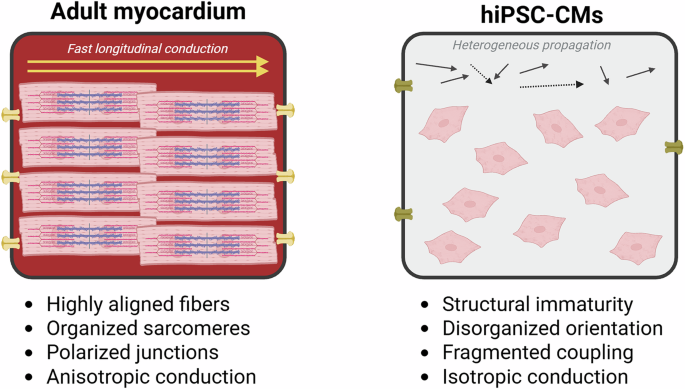

Moriwaki, T., Tani, H. & Tohyama, S. Human induced pluripotent stem cell-derived cardiomyocytes for disease modeling and drug discovery. Front. Bioeng. Biotechnol. 13, 1687840 (2025).
Karakikes, I., Ameen, M., Termglinchan, V. & Wu, J. C. Human induced pluripotent stem cell-derived cardiomyocytes. Circ. Res. 117, 80–88 (2015).
Kawamura, M. et al. Feasibility, safety, and therapeutic efficacy of human induced pluripotent stem cell-derived cardiomyocyte sheets in a porcine ischemic cardiomyopathy model. Circulation 126, S29–S37 (2012).
Shiba, Y. et al. Allogeneic transplantation of iPS cell-derived cardiomyocytes regenerates primate hearts. Nature 538, 388–391 (2016).
Block, T. et al. Human perinatal stem cell derived extracellular matrix enables rapid maturation of hiPSC-CM structural and functional phenotypes. Sci. Rep. 10, 19071 (2020).
Funakoshi, S. et al. Enhanced engraftment, proliferation, and therapeutic potential in heart using optimized human iPSC-derived cardiomyocytes. Sci. Rep. 6, 19111 (2016).
Matsuo, T. et al. Efficient long-term survival of cell grafts after myocardial infarction with thick viable cardiac tissue entirely from pluripotent stem cells. Sci. Rep. 5, 16842 (2015).
Lane, K. V. et al. Cell architecture and dynamics of human induced pluripotent stem cell-derived cardiomyocytes (hiPSC-CMs) on hydrogels with spatially patterned laminin and N-cadherin. ACS Appl. Mater. Interfaces 17, 174–186 (2025).
Jain, A., Choudhury, S., Sundaresan, N. R. & Chatterjee, K. Essential role of anisotropy in bioengineered cardiac tissue models. Adv. Biol. 8, 2300197 (2024).
Costa, K. D., Lee, E. J. & Holmes, J. W. Creating alignment and anisotropy in engineered heart tissue: role of boundary conditions in a model three-dimensional culture system. Tissue Eng. 9, 567–577 (2003).
Kadota, S., Pabon, L., Reinecke, H. & Murry, C. E. In vivo maturation of human induced pluripotent stem cell-derived cardiomyocytes in neonatal and adult rat hearts. Stem Cell Rep. 8, 278–289 (2017).
Dwyer, K. D. & Coulombe, K. L. K. Cardiac mechanostructure: using mechanics and anisotropy as inspiration for developing epicardial therapies in treating myocardial infarction. Bioact. Mater. 6, 2198–2220 (2021).
Pasqualini, F. S., Sheehy, S. P., Agarwal, A., Aratyn-Schaus, Y. & Parker, K. K. Structural phenotyping of stem cell-derived cardiomyocytes. Stem Cell Rep. 4, 340–347 (2015).
Kowalski, W. J. et al. Quantification of cardiomyocyte alignment from three-dimensional (3D) confocal microscopy of engineered tissue. Microsc. Microanal. 23, 826–842 (2017).
Khan, M. et al. Evaluation of changes in morphology and function of human induced pluripotent stem cell derived cardiomyocytes (HiPSC-CMs) cultured on an aligned-nanofiber cardiac patch. PloS ONE 10, e0126338 (2015).
Kalkunte, N. G. et al. Engineering alignment has mixed effects on human induced pluripotent stem cell differentiated cardiomyocyte maturation. Tissue Eng. Part A 29, 322–332 (2023).
Pijnappels, D. A. et al. Forced alignment of mesenchymal stem cells undergoing cardiomyogenic differentiation affects functional integration with cardiomyocyte cultures. Circ. Res. 103, 167–176 (2008).
Satsuka, A. et al. Contractility assessment using aligned human iPSC-derived cardiomyocytes. J. Pharmacol. Toxicol. Methods 128, 107530 (2024).
Napiwocki, B. N. et al. Aligned human cardiac syncytium for in vitro analysis of electrical, structural, and mechanical readouts. Biotechnol. Bioeng. 118, 442–452 (2021).
Takada, T. et al. Aligned human induced pluripotent stem cell-derived cardiac tissue improves contractile properties through promoting unidirectional and synchronous cardiomyocyte contraction. Biomaterials 281, 121351 (2022).
Wang, P.-Y., Yu, J., Lin, J.-H. & Tsai, W.-B. Modulation of alignment, elongation and contraction of cardiomyocytes through a combination of nanotopography and rigidity of substrates. Acta Biomater. 7, 3285–3293 (2011).
Qin, M., Chen, X. & Zhu, P. Engineering cardiac tissue: the role of topographic cues in cardiomyocytes. J. Appl. Biomater. Funct. Mater. 23, 22808000251376084 (2025).
Bray, M. A., Sheehy, S. P. & Parker, K. K. Sarcomere alignment is regulated by myocyte shape. Cell Motil. Cytoskeleton 65, 641–651 (2008).
Kuo, P.-L. et al. Myocyte shape regulates lateral registry of sarcomeres and contractility. Am. J. Pathol. 181, 2030–2037 (2012).
Mohammadzadeh, S. & Lejeune, E. Quantifying HiPSC-CM structural organization at scale with deep learning-enhanced SarcGraph. PLoS Comput. Biol. 21, e1013436 (2025).
Drew, N. K., Johnsen, N. E., Core, J. Q. & Grosberg, A. Multiscale characterization of engineered cardiac tissue architecture. J. Biomech. Eng. 138, 1110031–1110038 (2016).
Choi, S. et al. Fibre-infused gel scaffolds guide cardiomyocyte alignment in 3D-printed ventricles. Nat. Mater. 22, 1039–1046 (2023).
Wang, S., Varray, F., Liu, W., Clarysse, P. & Magnin, I. E. Measurement of local orientation of cardiomyocyte aggregates in human left ventricle free wall samples using X-ray phase-contrast microtomography. Med. Image Anal. 75, 102269 (2022).
Navaee, F. et al. A three-dimensional engineered cardiac in vitro model: controlled alignment of cardiomyocytes in 3D microphysiological systems. Cells https://doi.org/10.3390/cells12040576 (2023).
Habeck, M. et al. Sarcomere analysis in human cardiomyocytes by computing radial frequency spectra. Biol. Chem. https://doi.org/10.1515/hsz-2025-0173 (2025).
Kotadia, I. et al. Anisotropic cardiac conduction. Arrhythm. Electrophysiol. Rev. 9, 202–210 (2020).
Han, J., Wu, Q., Xia, Y., Wagner, M. B. & Xu, C. Cell alignment induced by anisotropic electrospun fibrous scaffolds alone has limited effect on cardiomyocyte maturation. Stem Cell Res. 16, 740–750 (2016).
van Schie, M. S., Talib, S., Knops, P., Taverne, Y. J. H. J. & de Groot, N. M. S. Conduction velocity and anisotropic properties of fibrillation waves during acutely induced and long-standing persistent AF. JACC Clin. Electrophysiol. 10, 1592–1604 (2024).
Ding, M. et al. Aligned nanofiber scaffolds improve functionality of cardiomyocytes differentiated from human induced pluripotent stem cell-derived cardiac progenitor cells. Sci. Rep. 10, 13575 (2020).
Kumar, N. et al. Scalable biomimetic coaxial aligned nanofiber cardiac patch: a potential model for “Clinical Trials in a Dish”. Front. Bioeng. Biotechnol. 8, 567842 (2020).
Carson, D. et al. Nanotopography-induced structural anisotropy and sarcomere development in human cardiomyocytes derived from induced pluripotent stem cells. ACS Appl. Mater. Interfaces 8, 21923–21932 (2016).
Feinberg, A. W. et al. Controlling the contractile strength of engineered cardiac muscle by hierarchal tissue architecture. Biomaterials 33, 5732–5741 (2012).
Suh, T. C., Amanah, A. Y. & Gluck, J. M. Electrospun scaffolds and induced pluripotent stem cell-derived cardiomyocytes for cardiac tissue engineering applications. Bioengineering 7, 105 (2020).
English, E. J., Samolyk, B. L., Gaudette, G. R. & Pins, G. D. Micropatterned fibrin scaffolds increase cardiomyocyte alignment and contractility for the fabrication of engineered myocardial tissue. J. Biomed. Mater. Res. A 111, 1309–1321 (2023).
Prabhakaran, M. P., Kai, D., Ghasemi-Mobarakeh, L. & Ramakrishna, S. Electrospun biocomposite nanofibrous patch for cardiac tissue engineering. Biomed. Mater. 6, 055001 (2011).
Liu, L. et al. Integrated manufacturing of suspended and aligned nanofibrous scaffold for structural maturation and synchronous contraction of HiPSC-derived cardiomyocytes. Bioengineering 10, 702 (2023).
Eom, S. et al. Fabrication of an align-random distinct, heterogeneous nanofiber mat endowed with bifunctional properties for engineered 3D cardiac anisotropy. Compos. B Eng. 226, 109336 (2021).
Liu, S. et al. Multiscale anisotropic scaffold integrating 3D printing and electrospinning techniques as a heart-on-a-chip platform for evaluating drug-induced cardiotoxicity. Adv. Healthc. Mater. 12, 2300719 (2023).
Zhang, Y. S. et al. Bioprinting 3D microfibrous scaffolds for engineering endothelialized myocardium and heart-on-a-chip. Biomaterials 110, 45–59 (2016).
Lemoine, M. D. et al. Human iPSC-derived cardiomyocytes cultured in 3D engineered heart tissue show physiological upstroke velocity and sodium current density. Sci. Rep. 7, 5464 (2017).
Kai, D., Prabhakaran, M. P., Jin, G. & Ramakrishna, S. Guided orientation of cardiomyocytes on electrospun aligned nanofibers for cardiac tissue engineering. J. Biomed. Mater. Res. B Appl. Biomater. 98B, 379–386 (2011).
Gao, L. et al. Large cardiac muscle patches engineered from human induced-pluripotent stem cell-derived cardiac cells improve recovery from myocardial infarction in swine. Circulation 137, 1712–1730 (2018).
Dou, W. et al. A microdevice platform for characterizing the effect of mechanical strain magnitudes on the maturation of iPSC-cardiomyocytes. Biosens. Bioelectron. 175, 112875 (2021).
Lu, K. et al. Progressive stretch enhances growth and maturation of 3D stem-cell-derived myocardium. Theranostics 11, 6138 (2021).
Song, M., Jang, Y., Kim, S.-J. & Park, Y. Cyclic stretching induces maturation of human-induced pluripotent stem cell-derived cardiomyocytes through nuclear-mechanotransduction. Tissue Eng. Regen. Med. 19, 781–792 (2022).
Stephanie, G. A. & Vander Roest, A. S. Cardiac disease mechanobiology: advances using hiPSC-CMs. Front. Cardiovasc. Med. 12, 1642931 (2025).
Jebran, A.-F. et al. Engineered heart muscle allografts for heart repair in primates and humans. Nature 639, 503–511 (2025).
Lu, Y., Liu, Y., Yan, Y., Fooladi, S. & Qyang, Y. Advancements in techniques for human iPSC-derived cardiomyocytes maturation: mechanical and electrical stimulation approaches. Biophys. Rev. 17, 169–183 (2025).
Kroll, K. et al. Electro-mechanical conditioning of human iPSC-derived cardiomyocytes for translational research. Prog. Biophys. Mol. Biol. 130, 212–222 (2017).
Pok, S. et al. Biocompatible carbon nanotube–chitosan scaffold matching the electrical conductivity of the heart. ACS Nano 8, 9822–9832 (2014).
Mihic, A. et al. A conductive polymer hydrogel supports cell electrical signaling and improves cardiac function after implantation into myocardial infarct. Circulation 132, 772–784 (2015).
Song, X. et al. Cardiac-adaptive conductive hydrogel patch enabling construction of mechanical-electrical anisotropic microenvironment for heart repair. Research 6, 0161 (2023).
Cano-Jorge, M., Gómez, S., den Toonder, J., Wang, Y. & Passier, R. In vitro approaches to mimic cardiac mechanical load dynamics for enhancing maturation and disease modelling. Cardiovasc. Res. 121, 2484–2502 (2025).
Richards, D. J. et al. Nanowires and electrical stimulation synergistically improve functions of hiPSC cardiac spheroids. Nano Lett. 16, 4670–4678 (2016).
Sterckel, S., Passier, R. & Rivera-Arbelaez, J. M. Electrical stimulation: a missing key to promote maturation of human pluripotent stem cell-derived cardiomyocytes in three-dimensional cardiac tissues. Front. Bioeng. Biotechnol. 13, 1686342 (2025).
Jang, M. et al. Interaction of cardiomyocytes from CCND2-overexpressing human induced pluripotent stem cells with electrically conductive hydrogels. RSC Adv. 15, 21408–21423 (2025).
Khan, T., Vadivel, G., Ayyasamy, K., Murugesan, G. & Sebaey, T. A. Advances in conductive biomaterials for cardiac tissue engineering: design, fabrication, and functional integration. Polymers https://doi.org/10.3390/polym17050620 (2025).
Ghovvati, M., Kharaziha, M., Ardehali, R. & Annabi, N. Recent advances in designing electroconductive biomaterials for cardiac tissue engineering. Adv. Healthc. Mater. 11, 2200055 (2022).
Chen, J. et al. An injectable hydrogel based on phenylboronic acid hyperbranched macromer encapsulating gold nanorods and astragaloside IV nanodrug for myocardial infarction. Chem. Eng. J. 413, 127423 (2021).
Navaei, A. et al. Gold nanorod-incorporated gelatin-based conductive hydrogels for engineering cardiac tissue constructs. Acta Biomater. 41, 133–146 (2016).
Shin, S. R. et al. Carbon-nanotube-embedded hydrogel sheets for engineering cardiac constructs and bioactuators. ACS Nano 7, 2369–2380 (2013).
Zimmermann, W. H. et al. Engineered heart tissue grafts improve systolic and diastolic function in infarcted rat hearts. Nat. Med. 12, 452–458 (2006).
Gao, C., Lu, K., Ye, W., Li, L. & Cheng, L. Reconstruction of the architecture of ventricular myocardial fibers in ex vivo human hearts. Heart Surg. Forum 12, E225–E229 (2009).
Fang, Y. et al. Scalable fabrication of aligned myocardial tissues with native-like helical architecture for heart repair. Cell Biomater. https://doi.org/10.1016/j.celbio.2025.100306 (2026).
Ripplinger, C. M. et al. Guidelines for assessment of cardiac electrophysiology and arrhythmias in small animals. Am. J. Physiol. Heart Circ. Physiol. 323, H1137–H1166 (2022).
Schüttler, D. et al. A practical guide to setting up pig models for cardiovascular catheterization, electrophysiological assessment and heart disease research. Lab. Anim. 51, 46–67 (2022).
Chong, J. J. et al. Human embryonic-stem-cell-derived cardiomyocytes regenerate non-human primate hearts. Nature 510, 273–277 (2014).
Romagnuolo, R. et al. Human embryonic stem cell-derived cardiomyocytes regenerate the infarcted pig heart but induce ventricular tachyarrhythmias. Stem Cell Rep. 12, 967–981 (2019).
Sridharan, D. et al. Preclinical large animal porcine models for cardiac regeneration and its clinical translation: role of hiPSC-derived cardiomyocytes. Cells 12, 1090 (2023).
Ye, L. et al. Cardiac repair in a porcine model of acute myocardial infarction with human induced pluripotent stem cell-derived cardiovascular cells. Cell Stem Cell 15, 750–761 (2014).
Kawaguchi, S. et al. Intramyocardial transplantation of human iPS cell-derived cardiac spheroids improves cardiac function in heart failure animals. JACC Basic Transl. Sci. 6, 239–254 (2021).
Zhang, H. et al. Reviving hearts, restoring lives: long-term outcomes of allogeneic iPSC-cardiomyocytes transplantation for advanced heart failure patients. JACC Basic Transl. Sci. 10, 253–255 (2025).
Silver, S. E., Barrs, R. W. & Mei, Y. Transplantation of human pluripotent stem cell-derived cardiomyocytes for cardiac regenerative therapy. Front. Cardiovasc. Med. 8, 707890 (2021).
Gibbs, C. E. et al. Graft-host coupling changes can lead to engraftment arrhythmia: a computational study. J. Physiol. 601, 2733–2749 (2023).
Jiménez-Sábado, V. et al. Electrophysiological phenotyping of hiPSC-derived atrial cardiomyocytes using automated patch-clamp: a platform for studying atrial inherited arrhythmias. Cells 14, 1941 (2025).
Nguyen, C. T., Dawkins, J., Bi, X., Marbán, E. & Li, D. Diffusion tensor cardiac magnetic resonance reveals exosomes from cardiosphere-derived cells preserve myocardial fiber architecture after myocardial infarction. JACC Basic Transl. Sci. 3, 97–109 (2018).
Obiweluozor, F. O. et al. Considerations in the development of small-diameter vascular graft as an alternative for bypass and reconstructive surgeries: a review. Cardiovasc. Eng. Technol. 11, 495–521 (2020).
Liu, T. et al. Advanced cardiac patches for the treatment of myocardial infarction. Circulation 149, 2002–2020 (2024).