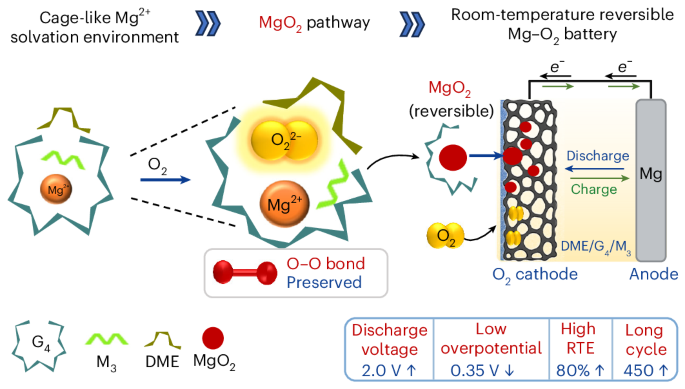

Xia, C. et al. A high-energy-density lithium–oxygen battery based on a reversible four-electron conversion to lithium oxide. Science 361, 777–781 (2018).
Liu, Q. et al. Aqueous metal–air batteries: fundamentals and applications. Energy Storage Mater. 27, 478–505 (2020).
Hopkins et al. Suppressing corrosion in primary aluminum–air batteries via oil displacement. Science 362, 658–661 (2018).
Li, C. S. et al. Current progress on rechargeable magnesium–air battery. Adv. Energy Mater. 7, 1700869 (2017).
Zhang, X. et al. Recent progress in rechargeable alkali metal–air batteries. Green Energy Environ. 1, 4–17 (2016).
Yadegari, H. et al. On rechargeability and reaction kinetics of sodium–air batteries. Energy Environ. Sci. 7, 3747–3757 (2014).
Yaru, W. et al. Challenges and prospects of M–air batteries: a review. Energy Mater. 2, 200024 (2022).
Zu, C.-X. & Li, H. Thermodynamic analysis on energy densities of batteries. Energy Environ. Sci. 4, 2614–2624 (2011).
Hu, D. et al. A review on thermal runaway warning technology for lithium-ion batteries. Renew. Sustain. Energy Rev. 206, 114882 (2024).
Ren, W. et al. An efficient bulky Mg[B(Otfe)4]2 electrolyte and its derivatively general design strategy for rechargeable magnesium batteries. ACS Energy Lett. 6, 3212–3220 (2021).
Sun, Y. et al. A facile strategy for constructing high-performance polymer electrolytes via anion modification and click chemistry for rechargeable magnesium batteries. Angew. Chem. Int. Ed. 63, e202406585 (2024).
Tong, F. et al. Mg–Sn alloys as anodes for magnesium–air batteries. J. Electrochem. Soc. 168, 110531 (2021).
Wang, Y. et al. Regulation of oxygen vacancies and electronic structures by substituting Ba2+ at A-sites of LaNi0.5Mn0.5O3 double perovskites enabling high-performance catalysts for Mg–air batteries. Appl. Surf. Sci. 639, 158287 (2023).
Smith, J. G. et al. Theoretical limiting potentials in Mg/O2 batteries. Chem. Mater. 28, 1390–1401 (2016).
Vardar, G. et al. Identifying the discharge product and reaction pathway for a secondary Mg/O2 battery. Chem. Mater. 27, 7564–7568 (2015).
Ng, K. L., Shu, K. & Azimi, G. A rechargeable Mg|O2 battery. iScience 25, 104711 (2022).
Shao, Y. et al. Coordination chemistry in magnesium battery electrolytes: how ligands affect their performance. Sci. Rep. 3, 3130 (2013).
Deivanayagam, R. et al. Progress in development of electrolytes for magnesium batteries. Energy Storage Mater. 21, 136–153 (2019).
Ren, W. et al. A chlorine-free electrolyte based on non-nucleophilic magnesium bis(diisopropyl)amide and ionic liquid for rechargeable magnesium batteries. ACS Appl. Mater. 13, 32957–32967 (2021).
Hou, S. et al. Solvation sheath reorganization enables divalent metal batteries with fast interfacial charge transfer kinetics. Science 374, 172–178 (2021).
Huang, H. et al. Enhancing H2O2 electrosynthesis at industrial-relevant current in acidic media on diatomic cobalt sites. J. Am. Chem. Soc. 146, 9434–9443 (2024).
Yang, X. et al. Tuning two-electron oxygen-reduction pathways for H2O2 electrosynthesis via engineering atomically dispersed single metal site catalysts. Adv. Mater. 34, 2107954 (2022).
Sun, Y. et al. Boosting electrochemical oxygen reduction to hydrogen peroxide coupled with organic oxidation. Nat. Commun. 15, 6098 (2024).
Gunasekara, I. et al. A study of the influence of lithium salt anions on oxygen reduction reactions in Li–air batteries. J. Electrochem. Soc. 162, A1055 (2015).
Witte, K. et al. Magnesium K-edge NEXAFS spectroscopy of chlorophyll A in solution. J. Phys. Chem. B 120, 11619–11627 (2016).
Tuerxun, F. et al. Effect of interaction among magnesium ions, anion, and solvent on kinetics of the magnesium deposition process. J. Phys. Chem. C 124, 28510–28519 (2020).
Trcera, N. et al. Experimental and theoretical study of the structural environment of magnesium in minerals and silicate glasses using X-ray absorption near-edge structure. Phys. Chem. Miner. 36, 241–257 (2009).
Welland, M. J. et al. An atomistically informed mesoscale model for growth and coarsening during discharge in lithium–oxygen batteries. J. Chem. Phys. 143, 224113 (2015).
Shiga, T. et al. Catalytic cycle employing a TEMPO–anion complex to obtain a secondary Mg–O2 battery. J. Phys. Chem. Lett. 5, 1648–1652 (2014).
Dong, Q. et al. Enabling rechargeable non-aqueous Mg–O2 battery operations with dual redox mediators. Chem. Commun. 52, 13753–13756 (2016).
Shiga, T. et al. A rechargeable non-aqueous Mg–O2 battery. Chem. Comm. 49, 9152–9154 (2013).
Peng, Z. et al. A reversible and higher-rate Li–O2 battery. Science 337, 563–566 (2012).
Liu, T. et al. Mechanistic insights into the challenges of cycling a nonaqueous Na–O2 battery. J. Phys. Chem. Lett. 7, 4841–4846 (2016).
Qin, L. et al. From K–O2 to K–air batteries: realizing superoxide batteries on the basis of dry ambient air. Angew. Chem. Int. Ed. 59, 10498–10501 (2020).
Ye, L. et al. A rechargeable calcium–oxygen battery that operates at room temperature. Nature 626, 313–318 (2024).
Sun, W. et al. A rechargeable zinc–air battery based on zinc peroxide chemistry. Science 371, 46–51 (2021).
Bogolowski, N. & Drillet, J.-F. An electrically rechargeable Al–air battery with aprotic ionic liquid electrolyte. ECS Trans. 75, 85 (2017).
Nölle, R. et al. A reality check and tutorial on electrochemical characterization of battery cell materials: how to choose the appropriate cell setup. Mater. Today 32, 131–146 (2020).
Plimpton, S. Fast parallel algorithms for short-range molecular dynamics. J. Comput. Phys. 117, 1–19 (1995).
Li, J. et al. Electric Field-driven ultraefficient Li+/Mg2+ separation through graphyne membrane. Ind. Eng. Chem. Res. 61, 18080–18089 (2022).
Doherty, B. et al. Revisiting OPLS force field parameters for ionic liquid simulations. J. Chem. Theory Comput. 13, 6131–6145 (2017).
Dodda, L. S. et al. LigParGen web server: an automatic OPLS-AA parameter generator for organic ligands. Nucleic Acids Res. 45, W331–W336 (2017).
Morrow, T. I. & Maginn, E. J. Molecular dynamics study of the ionic liquid 1-n-butyl-3-methylimidazolium hexafluorophosphate. J. Phys. Chem. B 106, 12807–12813 (2002).
Martínez, L. et al. PACKMOL: a package for building initial configurations for molecular dynamics simulations. J Comput.Chem. 0, 2157–2164 (2009).
Jewett, A. I. et al. Moltemplate: a tool for coarse-grained modeling of complex biological matter and soft condensed matter physics. J. Mol. Biol. 433, 166841 (2021).
Momma, K. & Izumi, F. VESTA 3 for three-dimensional visualization of crystal, volumetric and morphology data. J. Appl. Crystallogr. 44, 1272–1276 (2011).
Humphrey, W., Dalke, A. & Schulten, K. VMD: visual molecular dynamics. J. Mol. Graph. 14, 33–38 (1996).
Stukowski, A. Visualization and analysis of atomistic simulation data with OVITO–the open visualization tool. Model. Simul. Mat. Sci. Eng. 18, 015012 (2010).
Hugo, V.-V. V. et al. Molecular modeling and synthesis of ethyl benzyl carbamates as possible ixodicide activity. Comput. Chem. 7, 1–26 (2018).