
Aaij, R. et al. Measurement of matter–antimatter differences in beauty baryon decays. Nat. Phys. 13, 391–396 (2017).
Bar-Shalom, S., Soni, A. & Wudka, J. Theoretical underpinnings of CP-violation at the high-energy frontier. Phys. Lett. B 860, 139135 (2025).
Artuso, M. et al. Report of the frontier for rare processes and precision measurements. Preprint at https://arxiv.org/abs/2210.04765 (2022).
Safronova, M. S. et al. Search for new physics with atoms and molecules. Rev. Mod. Phys. 90, 025008 (2018).
Chupp, T. E., Fierlinger, P., Ramsey-Musolf, M. J. & Singh, J. T. Electric dipole moments of atoms, molecules, nuclei, and particles. Rev. Mod. Phys. 91, 015001 (2019).
Canetti, L., Drewes, M. & Shaposhnikov, M. Matter and antimatter in the universe. New J. Phys. 14, 095012 (2012).
Sakharov, A. D. Violation of CP invariance, C asymmetry, and baryon asymmetry of the universe. JETP Lett. 5, 24–27 (1967).
de Vries, J., Postma, M., van de Vis, J. & White, G. Electroweak baryogenesis and the standard model effective field theory. J. High Energy Phys. 2018, 89 (2018).
Isidori, G. & Straub, D. M. Minimal flavour violation and beyond. Eur. Phys. J. C 72, 1–14 (2012).
Greljo, A., Palavrić, A. & Thomsen, A. E. Adding flavor to the SMEFT. J. High Energy Phys. 2022, 10 (2022).
Georgi, H. Effective field theory. Annu. Rev. Nucl. Part. Sci. 43, 209–252 (1993).
Manohar, A. V. in Effective Field Theory in Particle Physics and Cosmology: Lecture Notes of the Les Houches Summer School Vol. 108 (eds Davidson, S. et al.) 47–136 (Oxford Univ. Press, 2020).
Hammer, H.-W., König, S. & Van Kolck, U. Nuclear effective field theory: status and perspectives. Rev. Mod. Phys. 92, 025004 (2020).
Isidori, G., Wilsch, F. & Wyler, D. The Standard Model effective field theory at work. Rev. Mod. Phys. 96, 015006 (2024).
Pospelov, M. & Ritz, A. Electric dipole moments as probes of new physics. Ann. Phys. 318, 119–169 (2005).
Engel, J., Ramsey-Musolf, M. J. & Van Kolck, U. Electric dipole moments of nucleons, nuclei, and atoms: the Standard Model and beyond. Prog. Part. Nucl. Phys. 71, 21–74 (2013).
Alarcon, R. et al. Electric dipole moments and the search for new physics. Preprint at https://arxiv.org/abs/2203.08103 (2022).
Seng, C.-Y. Reexamination of the standard model nucleon electric dipole moment. Phys. Rev. C 91, 025502 (2015).
Dragos, J., Luu, T., Shindler, A., de Vries, J. & Yousif, A. Confirming the existence of the strong CP problem in lattice QCD with the gradient flow. Phys. Rev. C 103, 015202 (2021).
Ema, Y., Gao, T. & Pospelov, M. Standard model prediction for paramagnetic electric dipole moments. Phys. Rev. Lett. 129, 231801 (2022).
Hook, A. TASI lectures on the strong CP problem and axions. Preprint at https://arxiv.org/abs/1812.02669 (2018).
Abel, C. et al. Measurement of the permanent electric dipole moment of the neutron. Phys. Rev. Lett. 124, 081803 (2020).
De Vries, J., Draper, P., Fuyuto, K., Kozaczuk, J. & Sutherland, D. Indirect signs of the Peccei–Quinn mechanism. Phys. Rev. D 99, 015042 (2019).
Peccei, R. D. & Quinn, H. R. CP conservation in the presence of pseudoparticles. Phys. Rev. Lett. 38, 1440–1443 (1977).
Kim, J. E. & Carosi, G. Axions and the strong CP problem. Rev. Mod. Phys. 82, 557–601 (2010).
de Vries, J., Draper, P., Fuyuto, K., Kozaczuk, J. & Lillard, B. Uncovering an axion mechanism with the EDM portfolio. Phys. Rev. D 104, 055039 (2021).
Adams, C. et al. Axion dark matter. Preprint at https://arxiv.org/abs/2203.14923 (2022).
Cairncross, W. B. & Ye, J. Atoms and molecules in the search for time-reversal symmetry violation. Nat. Rev. Phys. 1, 510–521 (2019).
DeMille, D., Hutzler, N. R., Rey, A. M. & Zelevinsky, T. Quantum sensing and metrology for fundamental physics with molecules. Nat. Phys. 20, 741–749 (2024).
Roussy, T. S. et al. An improved bound on the electron’s electric dipole moment. Science 381, 46–50 (2023).
Andreev, V. et al. Improved limit on the electric dipole moment of the electron. Nature 562, 355–360 (2018).
Cesarotti, C., Lu, Q., Nakai, Y., Parikh, A. & Reece, M. Interpreting the electron EDM constraint. J. High Energy Phys. 2019, 59 (2019).
Panico, G., Pomarol, A. & Riembau, M. EFT approach to the electron electric dipole moment at the two-loop level. J. High Energy Phys. 2019, 090 (2019).
Brod, J. & Stamou, E. Electric dipole moment constraints on CP-violating heavy-quark Yukawas at next-to-leading order. J. High Energy Phys. 2021, 80 (2021).
Bahl, H. et al. Constraining the CP structure of Higgs-fermion couplings with a global LHC fit, the electron EDM and baryogenesis. Eur. Phys. J. C 82, 604 (2022).
Kley, J., Theil, T., Venturini, E. & Weiler, A. Electric dipole moments at one-loop in the dimension-6 SMEFT. Eur. Phys. J. C 82, 1–43 (2022).
Garcia Ruiz, R. F. et al. Spectroscopy of short-lived radioactive molecules. Nature 581, 396–400 (2020).
Arrowsmith-Kron, G. et al. Opportunities for fundamental physics research with radioactive molecules. Rep. Prog. Phys. 87, 084301 (2024).
Conn, C. J. et al. Production and spectroscopy of cold radioactive molecules. Preprint at https://arxiv.org/abs/2508.08368 (2025).
Gaffney, L. P. et al. Studies of pear-shaped nuclei using accelerated radioactive beams. Nature 497, 199–204 (2013).
Auerbach, N., Flambaum, V. V. & Spevak, V. Collective T- and P-odd electromagnetic moments in nuclei with octupole deformations. Phys. Rev. Lett. 76, 4316–4319 (1996).
Hutzler, N. R. Polyatomic molecules as quantum sensors for fundamental physics. Quantum Sci. Technol. 5, 044011 (2020).
Anderegg, L. et al. Quantum control of trapped polyatomic molecules for eEDM searches. Science 382, 665–668 (2023).
Takahashi, Y. et al. Engineered molecular clock transitions for symmetry violation searches. Preprint at https://arxiv.org/abs/2508.06787 (2025).
Schiff, L. I. Measurability of nuclear electric dipole moments. Phys. Rev. 132, 2194 (1963).
Flambaum, V. & Ginges, J. Nuclear Schiff moment and time-invariance violation in atoms. Phys. Rev. A 65, 032113 (2002).
Liu, C.-P. P., Ramsey-Musolf, M. J., Haxton, W. C., Timmermans, R. G. E. & Dieperink, A. E. L. Atomic electric dipole moments: the Schiff theorem and its corrections. Phys. Rev. C 76, 035503 (2007).
Engel, J. Nuclear Schiff moments and CP violation. Annu. Rev. Nucl. Part. Sci. 75, 129–151 (2025).
De Vries, J. et al. Parity-and time-reversal-violating nuclear forces. Front. Phys. 8, 218 (2020).
Dobaczewski, J., Engel, J., Kortelainen, M. & Becker, P. Correlating Schiff moments in the light actinides with octupole moments. Phys. Rev. Lett. 121, 232501 (2018).
Zhou, E., Yao, J., Engel, J. & Meng, J. Effects of beyond-mean-field correlations on nuclear Schiff moments. Preprint at https://arxiv.org/abs/2507.01369 (2025).
Engel, J., Friar, J. L. & Hayes, A. C. Nuclear octupole correlations and the enhancement of atomic time-reversal violation. Phys. Rev. C 61, 035502 (2000).
Dobaczewski, J. & Engel, J. Nuclear time-reversal violation and the Schiff moment of 225Ra. Phys. Rev. Lett. 94, 232502 (2005).
Butler, P. A. & Nazarewicz, W. Intrinsic reflection asymmetry in atomic nuclei. Rev. Mod. Phys. 68, 349–421 (1996).
Butler, P. A. Pear-shaped atomic nuclei. Proc. R. Soc. A Math. Phys. Eng. Sci. 476, 20200202 (2020).
Gnech, A., De Vries, J., Shain, S. & Viviani, M. Electric dipole moment of light nuclei in chiral effective field theory. EPJ Web Conf. 258, 06007 (2022).
Hergert, H. A guided tour of ab initio nuclear many-body theory. Front. Phys. 8, 379 (2020).
Butler, P. A. Octupole collectivity in nuclei. J. Phys. G Nucl. Part. Phys. 43, 073002 (2016).
Flambaum, V. & Feldmeier, H. Enhanced nuclear Schiff moment in stable and metastable nuclei. Phys. Rev. C 101, 015502 (2020).
Butler, P. A. et al. The observation of vibrating pear-shapes in radon nuclei. Nat. Commun. 10, 2473 (2019).
Butler, P. A. et al. Evolution of octupole deformation in radium nuclei from Coulomb excitation of radioactive 222Ra and 228Ra beams. Phys. Rev. Lett. 124, 042503 (2020).
Sushkov, O. P. Schiff moments of deformed nuclei. Phys. Rev. C 110, 015501 (2024).
Chen, M., Li, T., Dobaczewski, J. & Nazarewicz, W. Microscopic origin of reflection-asymmetric nuclear shapes. Phys. Rev. C 103, 034303 (2021).
Cao, Y., Agbemava, S. E., Afanasjev, A. V., Nazarewicz, W. & Olsen, E. Landscape of pear-shaped even-even nuclei. Phys. Rev. C 102, 024311 (2020).
Degenkolb, S., Elmer, N., Modak, T., Mühlleitner, M. & Plehn, T. A global view of the EDM landscape. Preprint at https://arxiv.org/abs/2403.02052 (2024).
Gaul, K. & Berger, R. Global analysis of CP-violation in atoms, molecules and role of medium-heavy systems. J. High Energy Phys. 2024, 100 (2024).
Ramsey-Musolf, M. J. & Vasquez, J. C. Left-right symmetry and electric dipole moments. A global analysis. Phys. Lett. B 815, 136136 (2021).
Brod, J., Cornell, J. M., Skodras, D. & Stamou, E. Global constraints on Yukawa operators in the standard model effective theory. J. High Energy Phys. 2022, 294 (2022).
Aebischer, J., Buras, A. J. & Kumar, J. SMEFT ATLAS: the landscape beyond the Standard Model. Preprint at https://arxiv.org/abs/2507.05926 (2025).
Dekens, W. et al. Unraveling models of CP violation through electric dipole moments of light nuclei. J. High Energy Phys. 2014, 69 (2014).
Froese, P. & Navrátil, P. Ab initio calculations of electric dipole moments of light nuclei. Phys. Rev. C 104, 025502 (2021).
Graner, B., Chen, Y., Lindahl, E. & Heckel, B. Reduced limit on the permanent electric dipole moment of 199Hg. Phys. Rev. Lett. 116, 161601 (2016).
Chen, T. et al. Relativistic exact two-component coupled-cluster study of molecular sensitivity factors for nuclear Schiff moments. J. Phys. Chem. A 128, 6540–6554 (2024).
Yu, S. S. et al. A conveyor-belt magneto-optical trap of CaF. Nat. Commun. 17, 1175 (2026).
Khasanov, S., Su, Y., Safarov, A., Tedila, H. M. & Mamatkulov, O. Major radioactive ion beam facilities: a brief global overview. Eur. Phys. J. Plus 140, 638 (2025).
Tarasov, O. B. et al. Observation of new isotopes in the fragmentation of 198Pt at FRIB. Phys. Rev. Lett. 132, 072501 (2024).
Abel, E. P. et al. Isotope harvesting at FRIB: additional opportunities for scientific discovery. J. Phys. G Nucl. Part. Phys. 46, 100501 (2019).
Patton, B. D. & Robinson, S. M. Minor actinide production at Oak Ridge National Laboratory. In Proc. Institute of Nuclear Materials Management (INMM) Annual Meeting https://resources.inmm.org/annual-meeting-proceedings/minor-actinide-production-oak-ridge-national-laboratory (Institute of Nuclear Materials Management, 2019).
Collins, E. D. et al. US heavy actinide production at Oak Ridge National Laboratory — ongoing actinide partitioning and transmutation programs. In Proc. 16th Information Exchange Meeting on Actinide and Fission Product Partitioning and Transmutation (IEMPT 16) https://www.ornl.gov/publication/us-heavy-actinide-production-oak-ridge-national-laboratory-ongoing-actinide (OECD Nuclear Energy Agency, 2020).
Sprouse, G. D. & Orozco, L. A. Laser trapping of radioactive atoms. Annu. Rev. Nucl. Part. Sci. 47, 429–461 (1997).
Tandecki, M. et al. Offline trapping of 221Fr in a magneto-optical trap from implantation of an 225Ac ion beam. J. Instrum. 9, P10013 (2014).
Fan, M. et al. Laser cooling and trapping of 224Ra+. Phys. Rev. Res. 5, 043201 (2023).
Udrescu, S. M. et al. Isotope shifts of radium monofluoride molecules. Phys. Rev. Lett. 127, 033001 (2021).
Wilkins, S. U. et al. Observation of the distribution of nuclear magnetization in a molecule. Science 390, 386 (2025).
Udrescu, S. M. et al. Precision spectroscopy and laser-cooling scheme of a radium-containing molecule. Nat. Phys. 20, 202–207 (2024).
Athanasakis-Kaklamanakis, M. et al. Electron correlation and relativistic effects in the excited states of radium monofluoride. Nat. Commun. 16, 2139 (2025).
Athanasakis-Kaklamanakis, M. et al. Radiative lifetime of the A2Π1/2 state in RaF with relevance to laser cooling. Phys. Rev. A 110, L010802 (2024).
Athanasakis-Kaklamanakis, M. et al. Laser spectroscopy and CP-violation sensitivity of actinium monofluoride. Nature 648, 562–568 (2025).
Hutzler, N. R., Lu, H.-I. & Doyle, J. M. The buffer gas beam: an intense, cold, and slow source for atoms and molecules. Chem. Rev. 112, 4803–4827 (2012).
Jadbabaie, A., Pilgram, N. H., Kłos, J., Kotochigova, S. & Hutzler, N. R. Enhanced molecular yield from a cryogenic buffer gas beam source via excited state chemistry. New J. Phys. 22, 022002 (2020).
Egorov, D., Lahaye, T., Schöllkopf, W., Friedrich, B. & Doyle, J. M. Buffer-gas cooling of atomic and molecular beams. Phys. Rev. A 66, 043401 (2002).
Kaleja, O. et al. The performance of the cryogenic buffer-gas stopping cell of SHIPTRAP. Nucl. Instrum. Methods Phys. Res. 463, 280–285 (2020).
Lund, K. et al. Online tests of the advanced cryogenic gas stopper at NSCL. Nucl. Instrum. Methods Phys. Res. B 463, 378–381 (2020).
Fitch, N. & Tarbutt, M. Laser-cooled molecules. Adv. At. Mol. Opt. Phys. 70, 157–262 (2021).
Augenbraun, B. L. et al. Direct laser cooling of polyatomic molecules. Adv. At. Mol. Opt. Phys. 72, 89–182 (2023).
Dilling, J., Blaum, K., Brodeur, M. & Eliseev, S. Penning-trap mass measurements in atomic and nuclear physics. Annu. Rev. Nucl. Part. Sci. 68, 45–74 (2018).
Olmschenk, S. et al. Measurement of the lifetime of the \(6{p}^{2}{{P}^{o}}_{1/2}\) level of Yb+. Phys. Rev. A 80, 022502 (2009).
Rosch, D., Wenz, H., Kalkstein, M., Kracke, A. & Vogel, M. Design and characterization of a linear quadrupole ion trap for the investigation of cold molecular ions. EPJ Tech. Instrum. 3, 5 (2016).
Hermanspahn, N. et al. Observation of the continuous Stern–Gerlach effect on an electron bound in an ion. Phys. Rev. Lett. 84, 427–430 (2000).
Rosenband, T. et al. Frequency ratio of Al+ and Hg+ single-ion optical clocks; metrology at the 17th decimal place. Science 319, 1808 (2008).
Schmidt, P. O. et al. Spectroscopy using quantum logic. Science 309, 749 (2005).
Wolf, F. et al. Non-destructive state detection for quantum logic spectroscopy of molecular ions. Nature 530, 457–460 (2016).
Chou, C.-W. et al. Preparation and coherent manipulation of pure quantum states of a single molecular ion. Nature 545, 203–207 (2017).
Chou, C.-W. et al. Frequency-comb spectroscopy on pure quantum states of a single molecular ion. Science 367, 1458–1461 (2020).
Calvin, A. et al. Single molecule infrared spectroscopy in the gas phase. Nature 621, 295–299 (2023).
Moses, S. A. et al. A race-track trapped-ion quantum processor. Phys. Rev. X 13, 041052 (2023).
Xu, S. et al. 3D-printed micro ion trap technology for quantum information applications. Nature 645, 362–368 (2025).
Chen, J.-S. et al. Sympathetic ground state cooling and time-dilation shifts in an \({{\rm{Al}}27}^{+}\) optical clock. Phys. Rev. Lett. 118, 053002 (2017).
Pagano, G. et al. Cryogenic trapped-ion system for large scale quantum simulation. Quantum Sci. Technol. 4, 014004 (2019).
Verma, M., Jayich, A. M. & Vutha, A. C. Electron electric dipole moment searches using clock transitions in ultracold molecules. Phys. Rev. Lett. 125, 153201 (2020).
Zhang, C., Yu, P., Jadbabaie, A. & Hutzler, N. R. Quantum-enhanced metrology for molecular symmetry violation using decoherence-free subspaces. Phys. Rev. Lett. 131, 193602 (2023).
Kozyryev, I. & Hutzler, N. R. Precision measurement of time-reversal symmetry violation with laser-cooled polyatomic molecules. Phys. Rev. Lett. 119, 133002 (2017).
Yu, P. & Hutzler, N. R. Probing fundamental symmetries of deformed nuclei in symmetric top molecules. Phys. Rev. Lett. 126, 023003 (2021).
Fan, M. et al. Optical mass spectrometry of cold RaOH+ and RaOCH3+ \({{\rm{R}}{\rm{a}}{\rm{O}}{\rm{C}}{\rm{H}}}_{3}^{+}\). Phys. Rev. Lett. 126, 023002 (2021).
Zülch, C., Gaul, K., Giesen, S. M., Garcia Ruiz, R. F. & Berger, R. Cool molecular highly charged ions for precision tests of fundamental physics. Preprint at https://arxiv.org/abs/2203.10333 (2022).
Fan, X., Myers, T. G., Sukra, B. A. D. & Gabrielse, G. Measurement of the electron magnetic moment. Phys. Rev. Lett. 130, 071801 (2023).
Karthein, J. et al. Electroweak nuclear properties from single molecular ions in a penning trap. Phys. Rev. Lett. 133, 033003 (2024).
Shuman, E. S., Barry, J. F. & DeMille, D. Laser cooling of a diatomic molecule. Nature 467, 820–823 (2010).
Isaev, T., Hoekstra, S. & Berger, R. Laser-cooled RaF as a promising candidate to measure molecular parity violation. Phys. Rev. A 82, 052521 (2010).
Isaev, T. A., Zaitsevskii, A. V. & Eliav, E. Laser-coolable polyatomic molecules with heavy nuclei. J. Phys. B 50, 225101 (2017).
Zhang, C., Yu, P., Conn, C. J., Hutzler, N. R. & Cheng, L. Relativistic coupled-cluster calculations of RaOH pertinent to spectroscopic detection and laser cooling. Phys. Chem. Chem. Phys. 25, 32613–32621 (2023).
Lasner, Z. D. et al. Magneto-optical trapping of a heavy polyatomic molecule for precision measurement. Phys. Rev. Lett. 134, 083401 (2025).
Bohn, J. L., Rey, A. M. & Ye, J. Cold molecules: progress in quantum engineering of chemistry and quantum matter. Science 357, 1002–1010 (2017).
Meyer, E. R. & Bohn, J. L. Electron electric-dipole-moment searches based on alkali-metal-or alkaline-earth-metal-bearing molecules. Phys. Rev. A 80, 042508 (2009).
Fleig, T. & DeMille, D. Theoretical aspects of radium-containing molecules amenable to assembly from laser-cooled atoms for new physics searches. New J. Phys. 23, 113039 (2021).
Kłos, J., Li, H., Tiesinga, E. & Kotochigova, S. Prospects for assembling ultracold radioactive molecules from laser-cooled atoms. New J. Phys. 24, 025005 (2022).
Marc, A., Hubert, M. & Fleig, T. Candidate molecules for next-generation searches of hadronic charge–parity violation. Phys. Rev. A 108, 062815 (2023).
Marc, A. & Fleig, T. Semi-hadronic charge–parity violation interaction constants in CsAg, FrLi and FrAg molecules. Eur. Phys. J. D 79, 19 (2025).
Vayninger, M. et al. Magneto-optical trap of silver and potassium atoms. Phys. Rev. A 112, 063306 (2025).
Liu, L. et al. Building one molecule from a reservoir of two atoms. Science 360, 900–903 (2018).
Cairncross, W. B. et al. Assembly of a rovibrational ground state molecule in an optical tweezer. Phys. Rev. Lett. 126, 123402 (2021).
Vutha, A. C., Horbatsch, M. & Hessels, E. A. Orientation-dependent hyperfine structure of polar molecules in a rare-gas matrix: a scheme for measuring the electron electric dipole moment. Phys. Rev. A 98, 032513 (2018).
Singh, J. T. A new concept for searching for time-reversal symmetry violation using Pa-229 ions trapped in optical crystals. Hyperfine Interact. 240, 392 (2019).
Ramachandran, H. D. & Vutha, A. C. Nuclear T-violation search using octopole-deformed nuclei in a crystal. Phys. Rev. A 108, 012819 (2023).
Morris, I. M. et al. Rare isotope-containing diamond colour centres for fundamental symmetry tests. Philos. Trans. R. Soc. A 382, 20230169 (2023).
Van Vleck, J. H. The dipolar broadening of magnetic resonance lines in crystals. Phys. Rev. 74, 1168–1183 (1948).
Kittel, C. & Abrahams, E. Dipolar broadening of magnetic resonance lines in magnetically diluted crystals. Phys. Rev. 90, 238–239 (1953).
Royce, E. B. & Bloembergen, N. Linear electric shifts in the paramagnetic resonance of Al2O3:Cr and MgO:Cr. Phys. Rev. 131, 1912–1923 (1963).
Mims, W. B. The Linear Electric Field Effect in Paramagnetic Resonance (Clarendon Press, 1976).
Yang, X., Wang, S., Wilkins, S. & Ruiz, R. G. Laser spectroscopy for the study of exotic nuclei. Prog. Part. Nucl. Phys. 129, 104005 (2023).
Kamiński, T. et al. Astronomical detection of radioactive molecule 26AlF in the remnant of an ancient explosion. Nat. Astron. 2, 778–783 (2018).
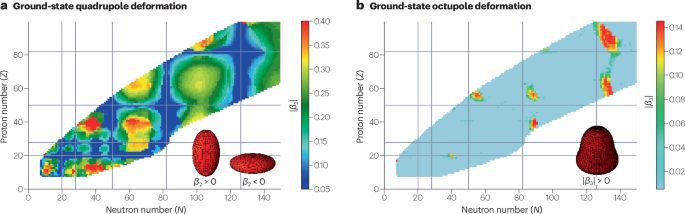
Moller, P., Sierk, A. J., Ichikawa, T. & Sagawa, H. Nuclear ground-state masses and deformations: FRDM(2012). At. Data Nucl. Data Tables 109–110, 1–204 (2016).
Kwon, H. Supersymmetry searches at ATLAS and CMS. Preprint at https://arxiv.org/abs/2506.06839 (2025).
The ATLAS Collaboration. The quest to discover supersymmetry at the ATLAS experiment. Phys. Rep. 1116, 261–300 (2024).
Sekmen, S. Supersymmetry searches in CMS run 2: a complete review. High. High Energy Phys. 1, 18 (2025).
Jayich, A. EDM-limits. Zenodo https://doi.org/10.5281/zenodo.20278872 (2025).