
To the best of our knowledge, this is the first report of a bimodal microstructure with full 3D reconstruction for Martian poikilitic shergottite (Fig. 6A, B). The 2D-XRD patterns show heterogeneous mosaic block sizes and orientation in a 300 × 300 μm area. Long streaks indicate misoriented mosaic blocks (<15 μm) caused by non-uniform strain, whereas the powder-ring pattern along the Debye rings reflects even smaller mosaic blocks (<5 μm) with nearly random orientation11,13,14,15,24,25,29,30. EBSD further confirmed that Type 1 subgrains have a uniform small size, weakly dispersed orientation, and limited accumulation of plastic strain, implying recrystallization rather than annealing; whereas Type 2 subgrains show preferred orientation with the extensive development of LAGBs. The coexistence of both textures within a single grain is inconsistent with a microstructure formed solely by a transient shock event, either by static annealing or shock-induced recrystallization. On the other hand, it is also unlikely to be formed by the shock-induced fragmentation or fracturing. Shock fractures are locally present in the investigated grain (Fig. 1A, B) and likely contributed to spatial strain heterogeneity and fragmentation. However, the observed subgrain structures and misorientation relationships are crystallographically coherent and characterized by systematic low-angle boundary development, indicating progressive lattice subdivision rather than simple fracture-controlled segmentation, suggesting the possible contribution from both magmatic strain and impact metamorphism. A general grain growth law may be expressed as follows:
$${d}^{n}-{d}_{0}^{n}={K}_{0}{e}^{-Q/\mathrm{RT}}t$$
(1)
where in Eq. (1) d and d0 are the final and initial grain sizes, respectively, K0 is a scaling factor, R is the gas constant, T is the temperature, n is the growth exponent of 2–5, Q is the activation energy from 160 to 620 kJ/mol depending on the presence of porosity and second phases, and t is time in seconds31,32,33,34. This relationship allows the characteristic grain size, which can form during a short thermal pulse, to be estimated as a function of temperature and duration.

A NWA 7721 recrystallite (Type 1 subgrain). B NWA 7721 relict subgrain (Type 2 subgrain). The top row is the view from the z-axis showing one layer, and the bottom row is the view rotation along the y-axis. C Åheim olivine. The full video is in the Supplementary Material.
The microstructure of the Type 1 subgrains suggests recrystallization under transient, high-temperature conditions rather than equilibrium static annealing, as indicated by their small grain size, subhedral morphology, and weakly dispersed crystallographic orientations. In shocked materials, recrystallization may occur during short-lived heating following rapid deformation, driven primarily by the release of stored strain energy within highly strained crystals. Migration of dislocations and subgrain boundaries promotes subdomain rotation and nucleation of new grains, while the high density of residual dislocations within the parent grain can limit subsequent grain coarsening21,34.
Previous studies suggest that poikilitic shergottites experienced deformation at high temperatures of 1750–1870 K and pressures of ≈55 GPa, inferred from the presence of shock melt and brown olivine35. Such conditions enhance dislocation mobility within strained olivine crystals and therefore facilitate recrystallization during transient heating events. To evaluate the conditions required for the formation of the Type 1 subgrains, we used experimentally derived grain-growth relations from the literature31,32,33,34. Using reported parameters (n, Q, and K0), we estimated the time required for olivine grains to grow to ≈5 μm across temperatures ranging from 1200 to 1900 K (Fig. 7).

Predicted time required for olivine grains to grow to ≈5 μm as a function of temperature, based on grain-growth relations reported in previous experimental studies. The comparison illustrates that micron-scale recrystallites may form rapidly at high temperatures, especially with dynamic recrystallization34. High porosity and dry static annealing conditions result in the slowest grain growth31.
Grain-growth relations reported in the literature describe grain-boundary migration controlled by diffusion-limited kinetics in olivine aggregates. The models compiled in Fig. 7, particularly those from Nichols and Mackwell31 and Karato33, predict broadly similar grain-growth timescales for micron-scale grains at high temperatures. Even under melt-assisted conditions, the relations reported by Faul and Scott32 with 2 and 4 wt% indicate growth times on the order of tens to hundreds of seconds at temperatures above ~1700 K, reflecting enhanced grain-boundary mobility but still governed primarily by diffusion-controlled processes. In contrast, dry porous conditions without melt or enhanced boundary mobility result in slower grain growth rates, with predicted times exceeding 102 s even at 1800 K31.
The duration of post-shock cooling ultimately controls the time available for recrystallization and therefore influences the final size of crystallites. Shock pulses during impact events are transient, typically lasting from nanoseconds to seconds, and the duration of post-shock annealing depends on the thermal diffusion length scale of the affected rock volume. In static annealing experiments on olivine shocked to 60 GPa36, no measurable textural modification was observed below 400 °C (equivalent to 673 K) regardless of annealing duration. Using 673 K as the lower limit of effective annealing temperature, and adopting a thermal diffusivity of olivine of 10−6 m2 s−1 10, the cooling time for a shock-heated region initially at 1800 K is estimated to be approximately 2.3 s for a characteristic diffusion length corresponding to a ~1 mm domain.
This short thermal pulse provides sufficient time for the nucleation and limited growth of fine recrystallites, consistent with the observed Type 1 subgrain sizes. In contrast, the Type 2 domains observed in EBSD and DFXM are substantially larger (>15 μm) and retain dense low-angle grain boundaries and crystallographic strain. The persistence of these structures indicates incomplete recrystallization rather than an absence of grain-growth capability. Therefore, the coexistence of fine recrystallized Type 1 subgrains and larger strained Type 2 domains is best explained by heterogeneous release of stored strain energy during short-lived post-shock heating, which promoted localized recrystallization while preserving portions of the pre-existing deformation fabric.
In addition to diffusion-controlled grain growth, stored strain energy provides an additional driving force for recrystallization in highly deformed crystals. Experimental studies such as Speciale et al.34 demonstrate that deformation-assisted recrystallization under constant strain-rate conditions can produce grain formation times substantially shorter than those predicted for purely static annealing models (Fig. 7). Following Speciale et al.34, we also plot a dry-condition model without the effect of water content, which results in a higher activation energy (≈620 kJ mol−1; olive-colored curve) and correspondingly slower growth compared to the wet condition (green-colored curve). In their experiments, recrystallization occurred under continuous deformation with sustained mechanical driving force, representing a classic dynamic recrystallization regime. In contrast, natural shock events involve a brief deformation pulse followed by rapid thermal relaxation. Therefore, the relations from Speciale et al.34 are used here to represent the intrinsic rate capability of deformation-assisted recrystallization, whereas the effective extent of recrystallization in shocked rocks is ultimately constrained by the duration of post-shock heating rather than by sustained deformation strain rate.
These kinetic relations indicate that micron-scale recrystallites (≈35 μm) may form rapidly during short-lived high-temperature events, consistent with the observed Type 1 subgrain sizes. The fine-grain size and limited subsequent growth suggest rapid nucleation followed by restricted grain coarsening during transient heating associated with the shock event. Shock melt observed surrounding the parent grains further suggests that recrystallization may have been locally enhanced by interstitial micro-melt; however, the primary driving force for the formation of the Type 1 subgrains is likely the release of stored strain energy through dislocation migration and boundary reorganization within the strained lattice during and immediately following shock compression.
Crystallization kinetics are also commonly described using the Johnson–Mehl–Avrami–Kolmogorov (JMAK) formulation for phase transformations37,38,39. The JMAK framework emphasizes the role of nucleation rate and growth kinetics in determining the temporal evolution of transformed volume. Although originally developed for phase transformations, this formulation highlights the general principle that the extent of recrystallization depends on both intrinsic kinetic rates and the duration of thermal exposure. In the present study, however, the focus is on recrystallization and grain-boundary migration within existing olivine crystals rather than bulk phase transformation. Therefore, experimentally derived grain-growth relations provide a more direct framework for estimating the timescales of subgrain formation in this system, while the JMAK concept provides useful context for understanding the time dependence of recrystallization processes.
In olivine, the development of shape-preferred orientation (SPO) accompanied by lattice-preferred orientation (LPO) generally reflects prolonged deformation under tectonic or magmatic strain conditions21,28,40,41,42. Such fabrics typically require sustained deformation and recovery processes to produce coherent alignment of grains and crystallographic orientations. In contrast, a single shock pulse operating on timescales of seconds is generally insufficient to generate well-developed aligned fabrics without significant post-shock annealing or deformation10,12. Consistent with this interpretation, previous studies of Martian meteorites have not documented systematic, regionally developed SPO or LPO fabrics attributable solely to shock metamorphism4,10,43,44. Therefore, we interpret the Type 2 subgrains as relics of pre-shock deformation preserved within the olivine crystal, with the observed SPO representing an inherited structural fabric from the parent grain. In contrast, the fine-grained Type 1 subgrains are interpreted as products of shock-assisted recrystallization that overprinted portions of the pre-existing deformation structure.
In addition to the development of shape-preferred orientation (SPO), the Type 2 subgrains further exhibit a dense dislocation network composed of very-low-angle boundaries. We interpret these as the hybrid microstructures recording both pre-shock plastic deformation and subsequent shock-induced modification. An experimental deformation study on olivine showed that repeated load-unload deformation cycles can generate strain hardening and internal back-stress, producing a Bauschinger effect in which stored elastic strain promotes yielding during reverse loading21. Such reverse dislocation motion can reorganize pre-existing dislocation structures into aligned dislocation walls and subgrain boundaries, providing a plausible mechanistic framework for the closely spaced LAGBs observed in the present study, linking the experimental observations directly to the microstructures documented here.
The dense dislocation network is only observed in Type 2 subgrains, indicating that these very-low-angle boundaries were not generated solely during the post-shock stage. Therefore, we interpret that the Type 2 subgrains, as preserved relics, experienced progressive deformation prior to the shock event. We propose that the grains were deformed in a simple-shear flow-like deformation at the late-stage of magma ascent and emplacement during the formation of non-poikilitic olivine. Previous studies of poikilitic shergottites suggest that non-poikilitic olivine commonly formed within partially crystalline magma systems, where sufficiently high crystal fractions allowed transmission of differential stress and development of intracrystalline deformation structures during magma flow4,6,45.
Based on the observed SPO with the approximate misorientation 20°, we estimated a finite non-coaxial bulk strain of γ ~0.3646, p. 9–11. This bulk strain corresponds to the incremental shear strain accommodated by dislocation glide forming the aligned very-low-angle boundaries spaced at approximately 10–25 μm. The incremental strain between adjacent LAGBS may be expressed as Δγ, representing the shear strain associated with each subdivision step. Using the observed boundary spacing and misorientation, we estimate Δγ ~ 0.036–0.0144 radians (equivalent to 2.1°–0.82°) following the dislocation-based deformation model of ref. 47. This observation is consistent with the experimental progressive subgrain rotation and fabric development in olivine under high-temperature shear42.
This estimated magnitude of intracrystalline strain is consistent with kernel average misorientation (KAM) values derived from the DFXM layer reconstruction (Fig. 6). In particular, the aligned LAGBS with a larger misorientation angle of 0.5°–1° produce the repeating orientation patterns visible in the autocorrelation analysis (Fig. 4E, F, Fig. 6B, C). In contrast, shock-related misorientations are typically smaller than 0.5° (Fig. 4C and Fig. 6B) and are randomly distributed between the LAGBS, contributing primarily to peak broadening rather than systematic periodicity in the autocorrelation signal (Fig. 4E, F).
A useful comparison may be made with olivine from the Åheim dunite, which records tectonic shear deformation. The Åheim sample exhibits similar periodic subboundary banding but produces narrower autocorrelation peaks (Fig. 5D, E), reflecting a more uniform deformation history. The mosaic spread measured from χ–μ space in the Åheim olivine is approximately twice that of the Type 1 subgrains but nearly four times smaller than that of the Type 2 subgrains. This difference indicates that the Type 2 subgrains experienced more intense or heterogeneous deformation than the tectonic reference sample, consistent with a history involving both magmatic strain and subsequent shock overprinting. Together, these observations support the interpretation that Type 2 subgrains preserve a pre-existing deformation fabric that was partially modified but not erased by the shock event, whereas the fine-grained Type 1 subgrains represent shock-assisted recrystallization products that are largely strain-free.
The current hypothesis for poikilitic shergottite is polybaric crystallization, where non-poikilitic olivine grains were formed during the ascent of magma toward the surface4,6. With the observations from our work, the aligned LAGBs with a repeating orientation pattern revealed in the Type 2 subgrains reflect an inherited pre-shock fabric that was subsequently partitioned and partially modified during the impact event rather than newly created by shock alone. The alignment of LAGBs is further evidenced by their periodic spacing of approximately 20–25 μm and the strong directional peak in the autocorrelation analysis, indicating a preferred boundary orientation rather than a random distribution.
We propose a three-stage process for the formation and preservation of these microstructures: (1) Pre-shock deformation: Late-stage ascent and degassing imposed localized simple-shear-like differential stresses, producing a strong internal orientation gradient and elevated geometrically necessary dislocations (GNDs) density within the parental crystal. The GNDs accumulation formed the aligned LAGBs, producing the triple-junctions and walls, which established long-range internal stresses. The kernel average misorientation (KAM) measurements provide a proxy for GND density, linking the observed spatial strain gradients to the proposed deformation history. (2) Shock loading and unloading: The compression shock wave propagated through the crystal containing this pre-existing deformation structure. During rapid unloading, the release of stored elastic strain generated internal backstress that promoted dislocation motion and boundary reorganization21. This process did not require perfect alignment between the earlier deformation geometry and the later shock stress direction; rather, the stored strain energy increased dislocation mobility, facilitating localized boundary migration and subdivision of the parent fabric into irregular subdomains bounded by LAGBs. (3) Post-shock retention: The brief post-shock heating, lasting only seconds, limited recovery and further boundary migration, preserving both (i) fine, nearly strain-free Type 1 recrystallites possibly formed near localized melt region, and (ii) large Type 2 relic domains with ≈0.5°–1° LAGBs, ≈20–25 μm banding, and incipient triple junctions that were partitioned from parent grain (Fig. 4D). Subsequent shock during atmospheric entry or terrestrial impact is unlikely to have significantly modified the observed microstructures, as these events typically generate lower peak pressures and shorter-duration shocks than primary planetary impact events10,12,48. Thus, the pre-existing magma ascent-related deformation fabric was preserved and locally modified, but not erased, by the shock event.
The common consensus for shergottites is that many of them likely share an ejection event at ca.3.0 Ma23, and 40Ar/39Ar ages of 161 ± 9 to 540 ± 63 Ma indicate sourcing from relatively young Martian volcanism22. NWA 7721 is paired with NWA 195049, yet its olivine preserves a distinctive bimodal texture: shock-produced, nearly strain-free Type 1 recrystallites along with shock-modified Type 2 relic subgrains within the same crystal.
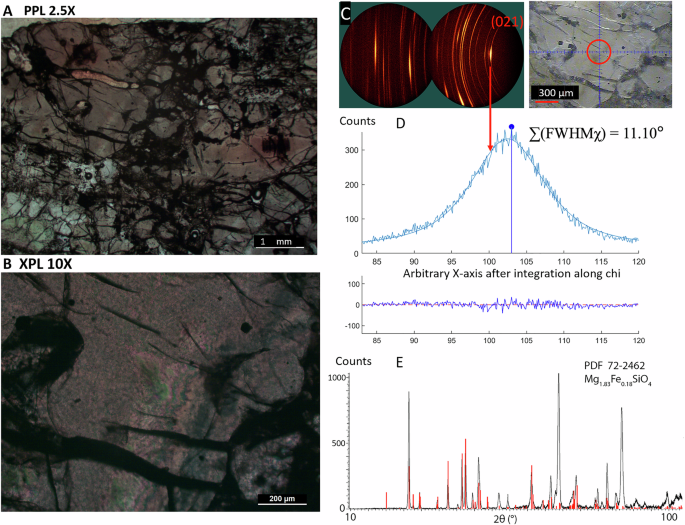
In the conventional meteorite shock classification scheme, stages range from weakly shocked (S1) to strongly shocked (S6), with S5 representing moderate to strong shock conditions characterized by pervasive mosaicism and localized melt generation10,12. Macroscopic staining, mosaicism, and local melt observed in NWA 7721 place the sample near the S5 shock stage. The quantitative strain-related mosaicity (SRM) analysis with a measured Σ(FWHMχ) value of 11.10°, consistent with the established relationship between increasing Σ(FWHMχ) and higher shock stage, reflecting progressively greater lattice distortion and crystallographic disorder in shocked olivine14,24,50. This quantitative result is therefore consistent with the overall petrographic assessment of the sample as moderately to strongly shocked. Grain-growth kinetics constrain post-shock heating to ~2.3 s, too short for full recovery, allowing pre-existing dislocation networks to persist and to be partitioned rather than erased. The absence of pervasive high-pressure phases with only localized melt supports a moderate-intensity, short-duration shock applied to a pre-strained but relatively cold target, distinguishing NWA 7721 from cases such as ALH A7700551.
Our multiscale observations establish a coherent link from optical textures and 2D XRD to EBSD and 3D DFXM microstructures. Specifically, the study integrates observations spanning millimeter-scale petrographic textures, micrometer-scale grain and subgrain geometries, and sub-degree crystallographic misorientation distributions resolved in volume. EBSD shows the apparent shock mosaicism composed of fine, nearly strain-free Type 1 recrystallites and large Type 2 relic subgrains with strong SPO and low-angle boundary network, embedded within a macroscopic single crystal. DFXM further deconvolutes these observations in volume: Type 1 subgrains are ~5–7 μm, measured by EBSD maps and the reconstruction of DFXM images, and are bounded by very-low-angle (<0.05°) interfaces. In contrast, Type 2 subgrains (>15–30 μm) exhibit ~0.5°–1∘ LAGBs that define subdomains and ~20–25 μm banding. The low-angle networks with misorientation angles below ~0.1° produce broadening of autocorrelation peaks, reflecting localized crystallographic disorder introduced during shock. These networks differ from the periodic banding observed in the Åheim analog, which exhibits narrower misorientation distributions and more uniform deformation fabrics, indicating a more homogeneous deformation history.
This study highlights the value of multi-scale observations for decoding complex meteoritic deformation. The successful application of DFXM delivers non-destructive, volumetric reconstructions of microstructure, complementing the conventional optical and EBSD analyses. Collectively, the integrated multiscale observations in this study demonstrate that NWA 7721 retains a record of olivine deformation produced both by shock and by earlier deformation within the Martian crust as recently as 130–600 Ma23,52,53.